Wednesday, January 29, 2020

A Patriarch Named for Kongi


A Patriarch Named for Kongi

High in the mountains of Lebanon, in a UNESCO World Heritage site is a cedar tree named after Africa’s first Nobel Laureate, Professor Wole Soyinka, and an impressive sculpture made from the ancient tree
 “Come over; this here is named for Prof Soyinka. He came to the grove in 2014 but it was in the winter, and the ground was covered with a fine layer of snow. It was slippery and treacherous for an older man. He couldn’t go further, so he just got here, hugged this tree and turned back,” our lecturer who doubled as the tour guide, Professor Joseph Rahme, explained as we began our tour of the Cedars of God grove high in the mountains of Lebanon.

The “we” were the 10 Nigerian participants in the 2018 edition of Study Abroad in Lebanon (SAIL), alongside our Lebanese classmate, Rachid, Prof Rahme’s nephew, who had set out earlier that morning from the Notre Dame University (NDU) Louaize, our main base.
SAIL is a programme of the NDU’s Benedict XVI Endowed Chair of Religious, Cultural, and Philosophical Studies in collaboration with The Cedars Institute and the Wole Soyinka Foundation (WSF). Its grand objective is to teach Nigerians world history through the eyes of Lebanon but with emphasis on Lebanese-Nigerian cultural relations. Two previous editions of SAIL had occurred in which Nigerian students had participated in the programme. We were the third.

We had set out early in the morning and had travelled some scary bends and turns beside deep gorges the likes of which a number of us had only seen in movies on our way to the quiet, beautiful village nestled over 6,000 feet above sea level and also named Cedars where we spent the next three days. Though most, except the lawyer, Aseobong Larry-Ettah, who had a phobia for heights, pretended not to be scared during the trip, we later voiced our concerns to each other after our arrival in the community first settled in the 1920s.

We had had lunch on the way and briefly stopped at the Natural Cedar Reserve of Tannourine but our ever-reliable chaperone, Honoree Claris Eid had disclosed that a better sight awaited us at our destination. “The cedar trees here are nothing compared with what we have at the Cedars of God,” she said while explaining why we wouldn’t go inside the Tannourine Reserve.
We headed promptly for the Cedars of God grove, one of the five UNESCO World Heritage Sites in Lebanon after we had refreshed, with Prof. Rahme, one of the main course instructors, giving us a detailed history of the reserve where pop star, Shakira, had a big concert earlier this year during the Cedars International Festival. The other faculties were Professor Edward Alam and Drs Chady Rahme and Tony Nasrallah, all of the NDU and Judge Mohamad Abou Zaid, President of Saida Islamic Sunni Court.

Occupying over 35 acres of land, the Cedars of God is enclosed by a wall built in 1883 to protect it. Queen Victoria of England provided funding for the wall. It was a timely move to save the trees, as persistent deforestation had significantly reduced their numbers.

It was a slow afternoon with only a few tourists around so we took our time on the tour that also doubled as a lecture with Prof Rahme, though a historian, displaying an incredible knowledge of botany and the cedar tree that he cares so deeply about and for which he and other like-minded persons established The Cedars Institute.

Rahme’s love for the trees mentioned over 50 times in the Bible is so profound that he knows all about their height and circumference and has christened them based on this.  The largest is the Pope followed by the patriarchs –one is named for Soyinka–bishops, priests, deacons, sub-deacons, and lay-people. To further underscore the importance of the cedar tree to Lebanon, it’s the symbol on the country’s flag, currency and postage stamps.

Explaining why the tree, with which King Solomon built his famous temple, is so valuable, our teacher said “they are straight and tall, between 40-50 metres high. They are ideal for building ships, palaces and temples. Cedars have natural bug repellent. They are heavy when freshly cut but light when dry and easy to work.”  The Phoenicians, Israelites, Egyptians, Assyrians, Persians, Romans and Turks all exploited cedars from Lebanon and are responsible for its near extinction.

Rahme further disclosed that there are three species of Cedars with the trio found together in only one location in the world. They are Cedrus Libani (found in Lebanon); Cedars of the Himalayas and Cedar of the Atlas Mountains of Morocco.  Luckily, Nigeria also has a cedar tree. There’s one at the University of Ibadan, planted by the late Father (Prof) Joseph Kenny of the Department of Religious Studies to whom it was gifted by Prof. Rahme.

The Professor also touched on the relationship between the African slave trade and the Cedar trees in Britain. He explained that some British colonialists and traders used proceeds of slavery to build gigantic mansions and estates and neo-classical gardens adorned with cedar trees but some of the trees didn’t last. They grew old and some fell during storms because their roots didn’t go deep into the ground enough.
Sadly, Lebanon is not exempt from the effects of global warming that has started affecting the health of the cedar trees. The trees wither after bugs unknown to the parts previously lay eggs on them. Those that can be saved are treated once identified while other uses are found for those beyond redemption or are very old like Rudy Rahme’s giant sculpture, ‘Christ on the Cross’. The impressive artwork from a cedar trunk has over eight figures sculpted from it. There are also the Two Hermits, so named because two hermits were believed to have lived in them in the 18th century.
Within the heritage site is also the Church of the Transfiguration of Jesus built in the 19th century and completely furnished with cedar wood. We all ensured we registered our names in the guest list inside the small church that was refurbished in the 20th century.
Cedar trees are known to live very long, with some said to be over 2,500 years old.  The oldest tree in the grove is one Rahme named ‘The Pope’. Unlike the other cedar trees that are straight, the Pope is crooked. The Professor explained that this accounts for its survival. “The oldest trees are crooked, and that’s why they survived. Straight trees were cut to build ships and temples. It’s not good to be straight, you survive when you are crooked,” he said tongue-in-cheek.
We were all enriched by the visit to the Cedars of God, but the tour appeared to have had the most profound effect impact on Lanre Fakeye, one of us known as Shakomended in music circles. He took up Professor’s Rahme’s suggestion to read the Epic of Gilgamesh and composed a beautiful song, ‘Cedars of Lebanon’ lamenting the persistent deforestation that had robbed the Mediterranean country of its precious trees.
https://goldentonesng.com/index.php/2019/03/09/a-patriarch-named-for-kongi/

Lebanon’s Hidden Wonder in Jeita Grotto

Lebanon’s Hidden Wonder in Jeita Grotto

November 4, 2018 3:25 am 


Jeita Grotto

Yinka Olatunbosun reports on a spectacular find in Lebanon, which is recognized as one of the UNESCO WorldHeritage sites

The first place of visit during the Study Abroad in Lebanon 2018 was Jeita Grotto, eight kilometres north of the traffic-prone Lebanese capital, Beirut. Our collective curiosity was aroused when Professor Joseph Rahme said the trip to Jeita Grotto would begin with a ride on a cable car.

The prospect of being transported on an endless stretch of cables above rough-edged mountains and deep valleys didn’t seem like a safe vacation idea to a narrow mind. Wild thoughts accompanied by sweaty palms and feet didn’t make it easy to look beyond the faces of the other occupants in the cable car so as to soak in the beauty of the mountainous terrain.

The cable car rose gradually until we couldn’t see the cable car attendant that bade us farewell. We eventually arrived at the upper cave and passed through security screening at the long tunnel.

The “No photography’’ sign was enforced thoroughly. All phones, cameras and other devices were taken into custody at the point of entry and the sight awaiting us left us with huge regrets for not breaking the rule.
Jeita Grotto, an interconnected cave having upper and lower galleries, was one of the 14 finalists in the New Seven Wonders of Nature. The upper galleries were accessed through a wet concrete pavement snaking up the unusual earth forms. Lit by intersecting lights, they are nature’s own sculptures and drip paintings- the world’s largest known stalactite.
We gasped, in complete awe and walked cautiously along the bends which is protected by a series of iron bars. It was a still moment of discovery and utter respect for its invisible creator.
We kept walking far behind our guide who pointed below, asking, “Can you see the water beneath the rocks? That’s the lower cave. We will go there after we are done here,’’ he said. Discovered in 1958 by Lebanese speleologists, the underground river in this magnificent cave is the source of drinking water to over a million Lebanese.

The walkways kept leading us upwards. We learnt as we walked in respectful silence that the cave is closed during winter because the water level rises to unsafe levels. We stood there, staring at the longest cave complex in eastern Mediterranean.

A colourful tourist train took us to the lower cave that we were eager to see. Some electric boats were waiting and our guide, Prof. Rahme, decided that one large boat was ideal for us. The boat man doubled as the security man. He spoke in angry Arabic as he discovered that some of us wanted to capture this amazing spectacle on our hidden devices.

We chose various seats- some were facing the direction we were heading while others had their backs to it.

The danger of belonging to the latter group was that some sharp protruding speleothems were waiting but the fun in the adventure came when the boatman’s yelled, “Stay down’’, and we quickly ducked to avoid designing our skulls with injuries or even disrupting the beautiful natural landscape.

As the electric boat sailed through the calm waters, we were allowed to touch the water and enjoy the therapeutic effect of nature, to prepare us for the rigorous 12-day travelling and study programme. As we took dinner by the cave, many of us were lamenting over the restriction of photography. Prof. Rahme looked at us in mischief, smiled and said, “You are Nigerians. I thought you could use your imagination. A few dollars would have gone a long way, you know.’’
 
That was our first initiation to Nigerian-Lebanese cultural relations. Obviously, Nigeria and Lebanon had so much in common than we had ever envisaged.

If we were in Nigeria, we would have known that we could easily get the photographs even with the restrictions. But with the security cameras and barking attendants and guides around Jeita Grotto, we thought we could go to prison if we dared to act like typical Nigerians who would attempt to bribe their way through.

Anyway, some Lebanese were offended that our lecturer, Prof Rahme told us about the power situation in Lebanon. Little did they know about where we were coming from: a state of chaotic generator noise whenever there is power outage.

Warmth was everywhere we went. Some Lebanese would pull over and request to take pictures with us, just because we were tourists. Initially, we thought they took us for African-Americans but when we introduced ourselves as Nigerians, we saw that they still loved us, ever more.

Prof. Rahme educated us about how Lebanese see Nigeria- it’s one of their dream places in the search for greener pastures.

When we asked our host Professor why the Jeita Grotto never got enlisted in the seven wonders of the world even though it made it to the finals, he revealed that voting limited Lebanon. Their small population could not pull the required votes.

He asked if Nigerians would support Lebanese by voting next time and our response was emphatic “yes’’.

Our return to Notre Dame University that evening was to read a few more chapters of the recommended text, Peter Frankopan’s “The Silk Roads” but most of us ended up connecting to WiFis and telling our folks about the most captivating sight we witnessed that day.

The SAIL programme is an initiative of the Wole Soyinka Foundation and a programme of the Benedict XVI Endowed Chair of Religious Cultural and Philosophical Studies at Notre Dame University, Louaize in collaboration with the Cedars’ Institute.

Reverend Sister Says Religion Will Not Unite Nigerians


Reverend Sister Says Religion Will Not Unite Nigerians 


The Reverend Sister said this on her arrival at Murtala Muhammed International Airport after a ten-day exchange program in Lebanon where she had the privilege to tour the country and learn about its culture and traditions. 

by SaharaReporters, New York Sep 24, 2017 

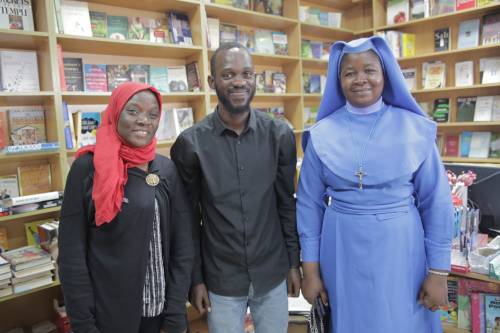
One of the participants of the Wole Soyinka Foundation and Cedars Institute sponsored Study Abroad In Lebanon (SAIL) program, Reverend Sister Mary Emilia Aboekwe, said she has come to the realization that religion will not unite Nigeria hence the need to downplay the presence of religion in the country.

The Reverend Sister said this on her arrival at Murtala Muhammed International Airport after a ten-day exchange program in Lebanon where she had the privilege to tour the country and learn about its culture and traditions.

Sister Aboekwe suggested the teaching of Islamic religion in Christian schools and vice versa, arguing that such will engender better understanding between Muslims and Christians alike. She said both Christians and Muslims worship the same god, and therefore the constant religious conflicts and misunderstandings are needless.

“After seeing what happened in Lebanon, I came to conclude that religion needs to be downplayed in Nigeria,” she said. “When we come out to discuss the unity of this nation, let us put religion aside, because it will not unite us. We will never be united when we talk of religion. Instead let us all believe that we are all children of God, created by one God.”

Referring to the agitation in the eastern part of Nigeria for a separate state, Sister Aboekwe advised the government to consider dialogue just as the Lebanese used to find closure after their long, brutal civil war.

“What I discovered in Lebanon is that they had long years of war, beginning from 1975, but what marveled me in Lebanon was the way they are living today. They have good infrastructural development despite the long years of war, so I began to wonder why Nigeria is the way it is today. 

We had only three years of civil war in Nigeria and the effects of war are still with us, but in Lebanon they have outgrown it.  In talking about the war and their losses, not repressing it, they were able to heal faster,” the Reverend Sister said.

She also urged the Nigerian government to learn financial prudence from the Lebanese government so they can invest Nigerian resources wisely.

Also sharing his experiences during the exchange program, Ademola Oloruntoba Adenle said he wished Nigeria would follow the Lebanese on history preservation. He opined that despite the influence of civilization, the Lebanese are consistent with their culture and traditions.

He also expressed excitement about the presence of African literature, particularly Nigerian literature, in the Lebanese schools.

“They look towards West Africa or Africa generally for literature. I heard a lecturer said he teaches Chinua Achebe’s Things Fall Apart in their university,” Mr. Adenle said.

Similarly, Salamatu Sule, another participant, agreed that Nigerian literature has much to offer the Lebanese because of its multiplicity in experiences and genres.

She encouraged Nigerians to learn from the smooth relationship among different religious groups in Lebanon.

Other beneficiaries of the program included Ayomide OladeleFaji, Blessing James Christopher, Christain Nyamali, Eyitemi Eyibojode Soyinka, Imam Khalid, Okani Chinelo Kasimma, and Oluwole Adegoke Adedoyin.

Lebanon, Soyinka Foundation, in cross cultural exchange


Lebanon, Soyinka Foundation, in cross cultural exchange


On September 11, 20166:11 pm

Share By Prisca Sam-Duru

Five Nigerian students, selected by their faculties from universities across the country departed Nigeria from Lagos, on Saturday, 27 August for Beirut. They joined students from other countries’ universities in a cultural study exchange programme titled, ‘Study Abroad In Lebanon, SAIL’. The SAIL programme is an initiative of CEDARS Institute, Notre Dame University, Lebanon, which is designed as an intensive course for international students, in the spirit of the global effort to promote dialogue between cultures. This was disclosed during a press conference in Lagos with Nobel Laureate, Professor Wole Soyinka, members of the Soyinka Foundation as well as the Lebanese initiator of the programme, Dr Jafaar Habib. Prof Soyinka said “I am interested in the efforts of the Wole Soyinka Foundation to try and expose youthful minds to all the cultures, civilisation, socio-political problems else where to ancient ways. Dr Jaffar is the brain behind the initiative, this is the first effort to participate in youthful exercises especially intellectual cultural artistic sides going on in other places. The five students selected for the SAIL programme is the first group which will be accompanied by Professor Ajayi Soyinka who is a gender study specialist.” The Lebanese fascilitator of the study programme, Dr Jafaar said it was a privilege for the “Wole Soyinka Foundation to be partnering with Cedars in the project dedicated to cultural exchanges and international collaboration. The partnership of the University of Notre Dame and Nigeria actually goes back some years, one of its most memorable initiatives being an international colloquium on the one year anniversary of the death of Professor Chinua Achebe. It was titled Honouring Chinua Achebe, a Lebanese-Nigerian Celebration, that event was presided over by the then Nigerian Ambassador Plenipotentiary, Amos Oluwole Idowu.” Five Nigerian students united with their counterparts from other countries in an intensive, interactive course on a syllabus designed to broaden their world perspectives. The students will be introduced to a modern Middle-Eastern nation with a complex history, filled with scenic surprises, a rich and facilitating cultural heritage, and a long experience in conflict resolution through experiments in governance systems. Dr Habib Jafaar who described himself as a Nigerian of Lebanese descent, having been born in Kano State and boasts of several business ventures in Nigeria, said through his life experience, has noticed that although Nigeria and Lebanon share a lot of experiences and challenges and are both multicultural and multi religious societies yet, “I find there are areas which are lacking in the social and cultural aspects of the relationship between these two countries and people. So over the years I have been in activities to improve that aspect among which is the Nigerian Lebanese initiative and most important is my recent work with the Wole Soyinka Foundation at the Cedars Institute of Lebanon.

Read more at: https://www.vanguardngr.com/2016/09/lebanon-soyinka-foundation-cross-cultural-exchange/

A Dinner By The Mediterranean

A Dinner By The Mediterranean By Akintayo Abodunrin ... On Sep 16, 2018 The 2018 edition of the Study Abroad in Lebanon Prog...